The Guardian
He has always been in the room. He has always tended the shelves. He has never asked why, until the objects begin to remember something he has forgotten.

I. Equilibrium
He did not know how long he had been in the room.
No...that was not quite right. He did not know if long meant anything in this place. Did time move through the room like it did in other places? Or did it simply accumulate, like dust on a surface that was never quite dirty? He did not know. The room was always the same temperature, neither hot nor cold. Its light came from nowhere in particular and went nowhere in particular. The light simply was, the way the room simply was. The way he simply was.
He knew the shelves.
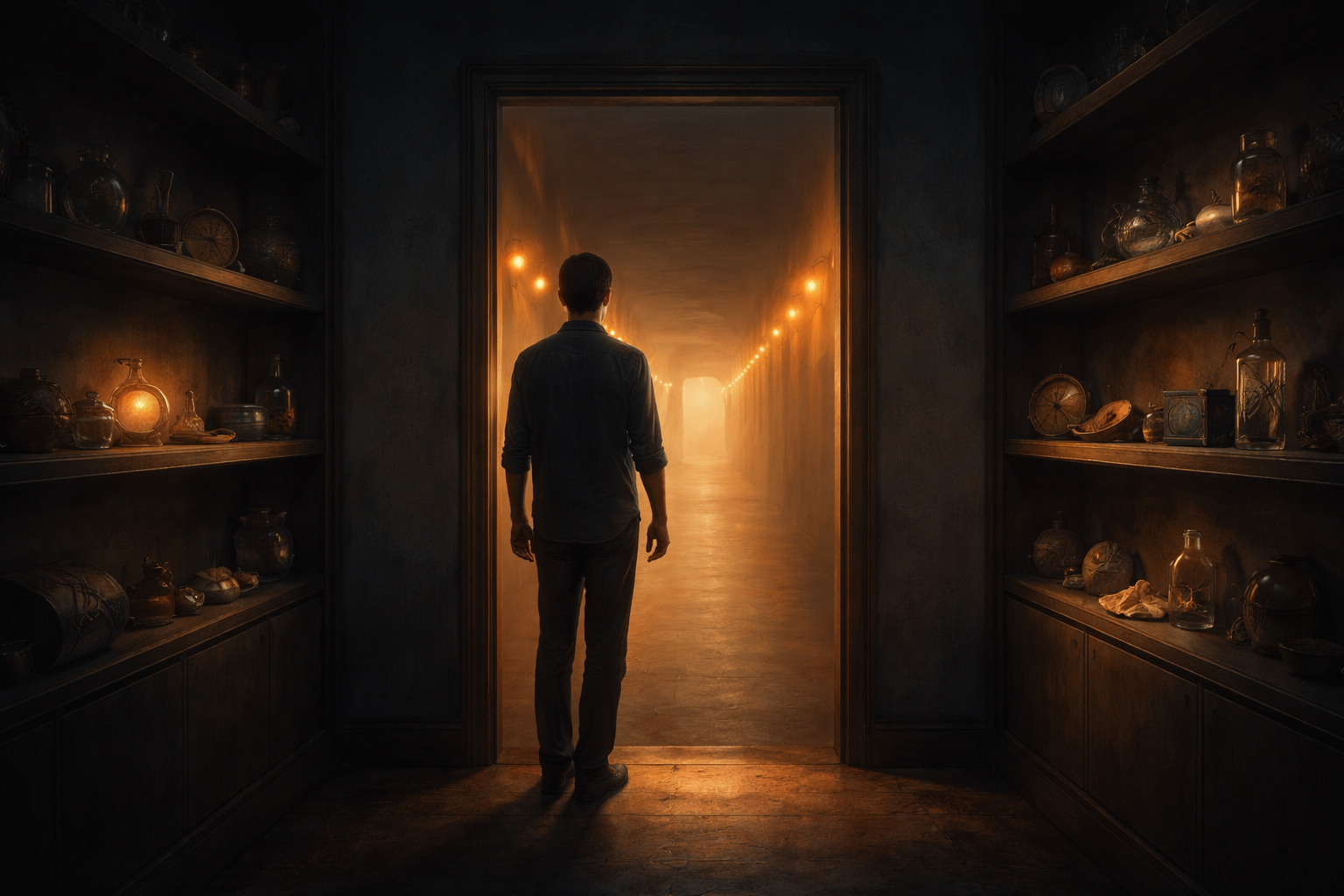
They lined three of the four walls from floor to ceiling, and on them sat objects. Small things, most of them, the kind that would fit in a closed hand. An old, brass compass with a needle that didn’t move. A toy car, the red paint peeling off. A length of ribbon, pale blue, coiled loosely around itself. A key with no teeth. A small glass bottle containing something that was not quite light and not quite liquid but suggested both. Hundreds of objects, perhaps more. He had never counted. Counting felt pointless in this place.
He moved along the shelves the way he always moved: unhurried, attentive. In the passing of time that was not time, some of the objects drifted. He straightened those. He lifted an object, turned it around in his fingers, set it back, adjusting it until it felt right again. Sometimes an object felt warm in a way he couldn’t understand, but which felt familiar. He would hold on to the warmth a moment longer before returning the object to its place. He did not ask why. Asking why also felt pointless.
The room had a single doorway. No door, just an opening in the fourth wall, beyond which stretched a corridor so long it ceased to be a corridor and became something else: a theory, a suggestion, a direction without destination. Lights hung at intervals along its length, small and amber, growing smaller until they were indistinguishable from stars. He had lingered in that doorway countless times. He never stepped through. He wasn’t certain he could. He wasn’t certain he wanted to.
The hum was the room’s constant companion and his. It lived somewhere below hearing, more felt than heard; a low, even resonance that seemed to come from the walls themselves, or from the objects, or from the space between them. It had always been there. He could not imagine the room without it.
He was holding a small serpent-shaped silver ring, a small smile on his face at its warmth, when the figure appeared.
It happened the way it always happened, without announcement, without transition. One moment the doorway was empty. The next, a shape stood in it: a woman, middle-aged, wearing clothes that seemed wrong for no reason he could name, her expression suspended somewhere between sleep and waking. She looked into the room without seeing it properly. Her eyes moved across the shelves, across him, and found nothing to hold onto. Her mouth opened slightly.
He watched her with the patience of long practice.
After seconds — or hours — she was gone. Not gone the way a person leaves a room, but gone the way a thought leaves the mind. Between one moment and the next, the doorway was empty again, and the amber lights receded into the distance, and the hum continued its steady note.
He turned back to the shelves. He put the ring back in its place, the warmth fading. He straightened a small ceramic figure he didn’t remember having touched.
He was waiting for someone. He didn’t know how he knew this. He simply did, the way he knew the shelves, the way he knew the hum. Somewhere underneath the routine of tending was a patient, directionless expectation. He had always been waiting. He assumed he always would be.
He did not think this was strange.
II. Disturbance
He noticed it first in the hum. Not a sound, exactly. A hesitation, the way a held breath is not quite silence. He paused mid-movement, fingers resting on the edge of a shelf, and listened with his whole body. The room looked the same. The objects sat in their places. The light was as it always was. But something had changed in the quality of the stillness, like a room looks the same after an argument as before one, except it isn’t.
He moved to the far shelf and saw it immediately: a small cluster of objects had shifted. Not fallen — nothing ever fell here — but moved, rotated, rearranged, as though something had passed through them. He frowned. He began to restore them to their original positions, working with the same careful patience, lifting each object in turn. A brown button, worn and scratched from use. A yellow lighter. A soft, round ball.
The fourth one stopped him.
It was a small stone, smoothed by water, grey-green, the kind a river makes over a long time. Ordinary. When his fingers closed around it, something moved through him. Not a thought, not a memory, but the shape of one. Warmth. But not the warmth he felt from other objects. This was the specific warmth of afternoon light through glass. And underneath it, so brief he nearly missed it, the sound of laughter. A woman’s laugh, low and unguarded, the kind that carried genuine mirth.
He stood very still.
The sensation passed, leaving nothing behind but an afterimage, the way a bright light does when you close your eyes. He turned the stone over once, twice. It was just a stone. He placed it carefully back on the shelf.
His hands were not quite steady.
The figure arrived without warning, as they always did. A young man this time, in the doorway, agitated, his eyes darting around as though looking for an exit. He was here and then he wasn’t. The doorway swallowed him back into the corridor and the amber lights burned on in the dark.
He looked at the river stone for a long moment.
Then he turned away and continued tending.
But the hum did not return to its former register. It was subtly, persistently different now. Not wrong, exactly. Searching. As though something in the room had stirred, and was waiting to see if he would stir with it.
III. Response
He knew there would be more. It was not one stone. It was never going to be just one stone.
The next came from a small wooden box, lacquered a deep blue, sitting near the top of the left-hand shelf. He noticed a hairline change in its position. He had to reach for it, and when he lifted it to examine, the flash came before he was ready: rain against glass, the close feeling of being inside while it rained, which was its own particular warmth, and beneath that — briefly, before it dissolved — the awareness of another presence beside him. Not a shape. Not a face. Just the certainty of someone there.
He replaced the box carefully and stood with his eyes closed for a moment.
He noticed many, after that: objects that hummed at a slightly different frequency than the others. A small copper container, etched with an unknown script, gave him the smell of bread baking and the low murmur of a voice he almost recognized. A folded square of cloth, once white, now the colour of old paper, carried the weight of a hand resting on his chest — brief, deliberate, the kind of touch that says stay. A smooth piece of sea-glass, pale green, broke open into an entire evening: the crackle of a fire, fingers entwined with his, the sound of a page turning in companionable silence, and beneath it all a contentment so specific it ached.
They felt right. Like they were his. He couldn’t understand it. Most of the objects felt neutral in his hands. Present, cared-for, but unremarkable. Items he watched over but that carried no weight of their own. But these others...these felt like reading his own handwriting in a language he’d forgotten how to speak.
The hum was no longer steady. It came in waves, rising and receding like a breath. The objects on the shelves trembled occasionally. Not enough to fall, but enough to notice. He moved through his tending with increasing urgency, straightening and restoring, but the room kept slipping out of order.
And then there was the pendant.
It had always been there. He understood that now with a certainty that had no clear origin. It sat on the lowest shelf of the right-hand wall, where it had been since before he could remember, which in this place meant it had been there always. A brass oval-shaped ring on a thick, brass chain, dark with age. He had tended everything around it with care. He had reached past it. He had, on some level he hadn’t examined, never looked at it directly, the way you learn not to look at a light that is too bright, except this wasn’t brightness. He didn’t know what it was. Perhaps pain. Perhaps fear. Perhaps something beyond words.
He knew it was connected to the waiting. He knew it was connected to the woman. He knew these things without having learned them, without being able to explain them. He knew, but he did not want to know.
He tidied around it again and moved to the next shelf.
The hum surged. An object fell and landed without sound on the floor. Nothing had ever fallen before. He stood in the centre of the room, very still. He looked at the ceiling. He looked at the doorway. Neither offered him anything. He did not want to look. He knew what he would find. He looked anyway.
It was the pendant.
He looked away.
The room waited.
IV. Answer
It took him minutes — or weeks — to gather the courage to look at it again. The pendant lay there, patiently. He picked it up on what might have been his hundredth pass, or his first real one.
It was cool in his palm for a moment — just a moment — and then it warmed quickly, more quickly than an object should, as though it had waited an eternity to be held and was relieved. The chain pooled between his fingers. He looked at the oval ring, at the empty space within it. He reached a trembling finger and gingerly touched its surface.
The room came apart.
Not violently, though. It came apart the way a held breath releases: all at once, a deep sigh of relief. The hum dissolved and in its place was sound. Real sound, layered and warm and enormous after so much quiet. A kitchen. A voice. Her voice, saying his name. His name, which he understood in that moment that he had forgotten, and which he could not quite hold onto even now but which felt like coming home. She said his name in that particular tone that meant she was only half-paying attention, that she was busy, that he was a familiar and beloved fixture in her peripheral vision, as she was in his.
He saw her.
Not all at once. In pieces, the way the other objects had given him pieces. But these were not fragments; they were complete moments, arriving in sequence, building something whole. Her at the kitchen table, one hand around a cup, reading. Her laughing at something he’d said, head tilted back. Her angry, genuinely angry, standing in a doorway not unlike this doorway, saying something he deserved to hear. Her asleep, her hair falling across her face. Her at a window, watching rain. Her — and this one arrived with a specific gravity, a specific weight — holding the pendant in both hands, looking at it with an expression he recognized as the one she wore when she was trying not to cry, which she mostly succeeded at, and he had bought her that pendant on a Tuesday for no reason, which she said was the best reason, and she had held it exactly like that.
He saw her.
He understood that she was still alive.
He expected his heart to be hammering. It did not come. He pressed his hand to his chest, the pendant still warm in the other, and found nothing: no pulse, no rhythm, no breath. He had never been breathing. The body he wore was a memory of a body. He understood this now. Not suddenly, but the way a word you have been trying to remember arrives. It had always been there, just beneath the surface, and now it was simply, quietly, undeniable.
The room exhaled around him.
He was not alive. He was not sure he had been for a very long time.
He stood with this for a long time. The room held still and silent around him, the way a person holds still around someone who is grieving, and he understood that it had always been doing this too.
The rest arrived without drama. Just a quiet settling, like a key turning in a lock that had always been there. He had died, and he had ended up here, in this room, in this particular purgatory, because he could not let go of her. The room was his. The room was him: his love, his vigil, his refusal. The objects he tended were the texture of their life together, objects and sensations he’d carried here without knowing he was carrying anything. The visitors brushed past and moved on, toward whatever came next, but he had not moved on. He had stayed, and in staying he had made a room, and in the room he had tended her memory like it was a living thing that needed him.
She was alive. She was moving through her days. She was grieving him, he understood, and she was also, slowly, continuing. She was doing the thing he had not done. She was letting go.
One more memory, and this one was different. Not a scene, but a feeling. Transmitted not through the pendant but through the air of the room itself, which was finally, after so long, completely still. A feeling of her: patient, clear, a little sad, generous in the way only the people who love us can be generous. No words. An orientation, like a compass finding north. Like being told, without being told, that the door was open, that it had always been open, that he had never been required to stay.
She had been trying to tell him that it was alright to go.
He stood for a long time, holding the pendant in his palm.
Then, reverently, he set it on the shelf.
V. Release
The room was quiet in a way it had not been quiet before. Not the taut stillness of waiting, but the loose, easy quiet of relief.
He moved along the shelves one last time, slowly, without urgency. He touched nothing. He looked at the objects with a different attention now. Not the attention of a guardian, but of someone taking leave. The river stone. The lacquered box. The sea-glass. The small serpent ring. A life, distributed across surfaces, tended and held. He had taken care of it. He had taken care of her, in the only way left to him, and it had been enough, and now his vigil had ended.
He walked to the doorway and stopped.
The corridor stretched before him, dark and amber and vast. Behind him, the room. His room. The shelves, the objects, the careful order of everything he had loved. He could stay. The thought arrived with a gentleness that made it dangerous. He could stay, and tend, and wait, and the room would let him. It had always let him.
His hand found the doorframe. He held it the way a person holds a railing at a great height. He closed his eyes and thought of her face. Not a memory this time, but an act of will. He thought of her at the kitchen table. He thought of her learning to fill the silence he had left. He thought of what it would mean to stay, that his vigil would go on, and on. But he knew she would feel it, some faint, unnameable weight at the edge of her grief that would not lift, because he had not lifted it. Because he had not let her go.
The corridor stretched away from him, amber lights burning at their intervals, receding into a vastness that implied not emptiness but everything else. Other lights in the distance. Other rooms, warm and quiet, each one a vigil, each one a love that had held on a little too long. He understood this now too. He was not the only one. He had never been the only one.
He had never been able to step through.
He let go of the doorframe and stepped through.
The room behind him was still and orderly. The objects sat in their places on the shelves. The brass pendant rested on the lowest shelf of the right-hand wall, its chain loose around it. The light came from nowhere and everywhere. The hum was gone.
From somewhere in the corridor, or somewhere beyond it, or somewhere that was not a place at all, the amber lights burned on.
They did not go out.
I publish reflections and stories about what it means to pay attention — to time, to growth, to the stories we tell ourselves about being alive.
If this one moved you, subscribe so the next one finds you.
If you know someone who might find meaning here, share this newsletter with them.